
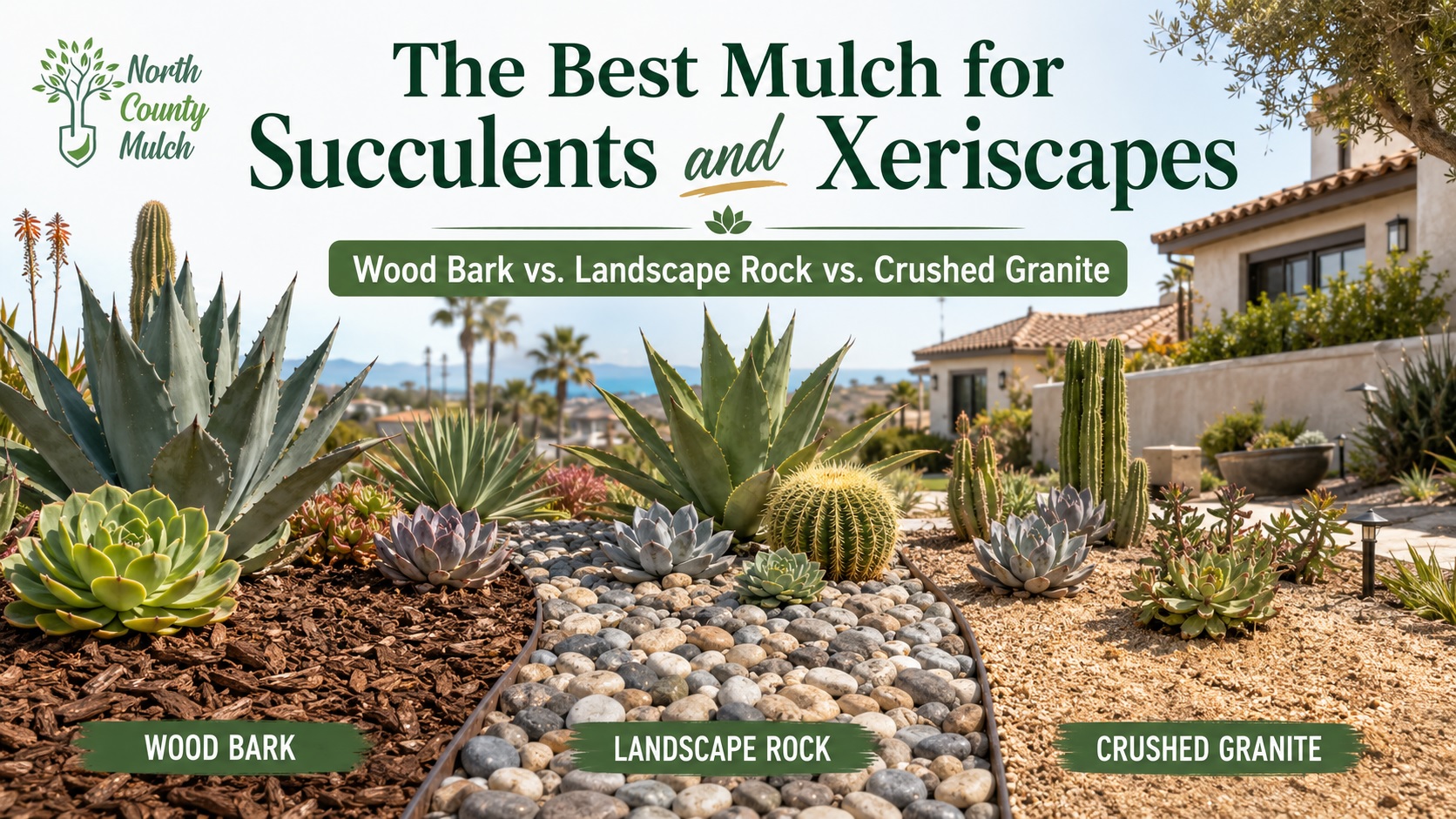
The best mulch for succulents is usually a mineral ground cover such as gravel, small decorative rock, or crushed granite installed over fast-draining soil. These materials keep succulent crowns cleaner and drier while allowing water to move through the surface. Small or medium bark can still work around drought-tolerant shrubs and trees, but deep organic mulch should not touch succulent stems or crowns. Decomposed granite is better suited to pathways and compacted open areas than directly around plants because its fine particles form a firmer surface.
Succulents, cacti, agaves, and drought-tolerant plants thrive throughout Escondido and North County, but they require a different ground-cover strategy than moisture-loving landscape plants. The wrong material or installation depth can trap water at the base of a plant and contribute to crown or root problems.
At North County Mulch, we supply bark, gravel, decorative rock, crushed granite, and decomposed granite for low-water landscapes across San Diego County.
Why Succulents Need Fast-Draining Ground Cover
Succulents store water inside their leaves, stems, or roots. Most perform best in porous soil that drains quickly and allows air to return to the root zone. UC guidance recommends fast-draining succulent soil containing substantial porous mineral material such as pumice, perlite, or decomposed granite.
Problems develop when irrigation, winter rainfall, compacted soil, and heavy mulch keep the plant crown continuously damp. Organic mulch is not automatically harmful, but deep layers placed directly against stems can hold excess moisture around vulnerable tissue. UC guidance recommends keeping mulch away from plant crowns because prolonged moisture may contribute to crown rot.
Rock Mulch vs. Wood Mulch
The best choice depends on the plants, soil, irrigation, appearance, and intended use of the area.
| Landscape Area | Recommended Material | Main Benefit |
|---|---|---|
| Succulents and cacti | Small gravel or decorative rock | Keeps crowns exposed and creates a clean mineral finish |
| Agaves and aloes | Gravel or crushed granite | Complements architectural plants and supports fast surface drainage |
| Xeriscape pathways | Decomposed granite | Compacts into a smooth walking surface |
| Drought-tolerant shrubs | Small or medium bark | Conserves moisture and adds organic matter |
| Areas near structures | Gravel, rock, or DG | Noncombustible surface option |
| Dry creek beds | River rock and gravel | Guides runoff while creating a natural design feature |
When Wood Bark Works
Small and medium bark are useful around established drought-tolerant shrubs, ornamental grasses, citrus trees, and planting beds where soil improvement and moisture conservation remain priorities.
Our small bark consists of fir bark pieces approximately one-quarter to one inch in size, while medium bark offers a larger one-to-two-inch texture. Both create a natural finish and reduce evaporation from exposed soil.
For succulent beds:
- Keep bark several inches away from crowns and stems
- Use a thinner layer in slow-draining soil
- Avoid directing drip emitters onto the plant base
- Remove bark that becomes heavily matted
- Consider a gravel ring immediately around each succulent
Wood bark is most useful when plants need moderated soil temperatures and some moisture retention. It is less suitable where excess water already collects.
Gravel and Small Landscape Rock
Gravel is often the most practical mulch for succulents because it provides a clean surface without decomposing around the crown. It also creates contrast against blue-green agaves, aloes, barrel cacti, and flowering succulents.
North County Mulch supplies pea gravel, crushed granite, decorative gravel, and other gravel and granite products for xeriscapes, pathways, borders, and drainage features.
Proper landscape rock installation still requires preparation. Rock placed directly over weeds or poorly graded soil will not correct drainage problems. A typical project may require:
- Removing weeds and unsuitable surface material
- Correcting low areas and drainage paths
- Installing edging to contain the rock
- Placing the selected gravel at a consistent depth
- Keeping plant crowns and irrigation outlets visible
Landscape fabric may help separate rock from soft soil in selected areas, but it should not block drainage or cover plant crowns.
Crushed Granite vs. Decomposed Granite
Crushed granite contains angular pieces that interlock while leaving spaces between particles. It works well for decorative beds, drainage strips, and areas where a rugged mineral texture is desired.
Decomposed granite, commonly called DG, contains finer weathered granite particles. When graded, moistened, and compacted correctly, it forms a smoother surface for pathways, patios, and garden borders. North County Mulch lists DG as a material suited to natural landscaping and drought-tolerant California projects.
DG should not be packed tightly over succulent root crowns. Keep a clear planting opening around each plant so irrigation and rain can enter the soil without burying the crown.
Best Rock for Drought-Tolerant Landscaping
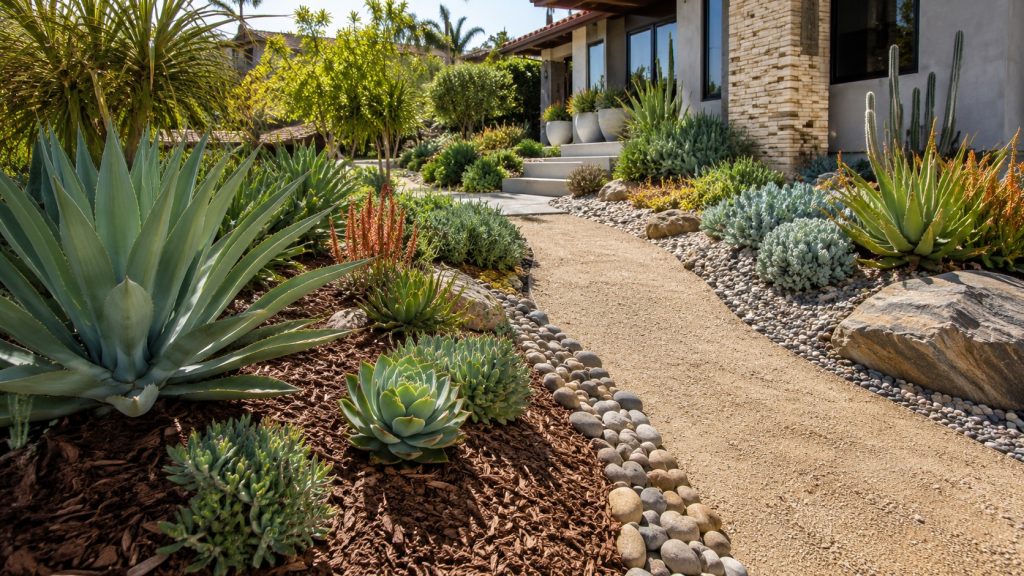
The best rock for drought-tolerant landscaping depends on the design:
- Use small gravel for detailed succulent beds
- Use crushed granite for durable borders and drainage areas
- Use DG for walkways and compacted open spaces
- Use river rock for swales and dry creek beds
- Use larger decorative stone as an accent among agaves and boulders
Mineral ground covers also support fire-conscious layouts. UC guidance identifies gravel and decomposed granite as noncombustible options for areas close to structures and recommends breaking up continuous organic mulch with rock or hardscape.
Succulent Garden Ground Cover in San Diego
A successful succulent garden ground cover in San Diego should manage water without creating a sealed surface. Before selecting bark or rock, check the native soil, slope, irrigation layout, sun exposure, and mature plant size.
At North County Mulch, we provide landscape rock, bark, gravel, DG, compost, and topsoil for properties in Escondido, Carlsbad, Oceanside, Poway, Fallbrook, and surrounding San Diego County communities. Our landscape material delivery service can bring bulk materials directly to residential and commercial projects.
Frequently Asked Questions
Is bark mulch bad for succulents?
Not always. Bark can be used around succulents when the soil drains well and the material is kept away from plant crowns. Mineral mulch is often easier to manage around rot-sensitive plants.
How deep should rock mulch be?
Approximately 2 to 3 inches works for many decorative landscape beds. The correct depth depends on rock size, edging, soil conditions, and expected foot traffic.
Is decomposed granite good around succulents?
DG can complement succulent landscapes, especially in pathways and open areas. Avoid compacting it tightly against plant crowns.