
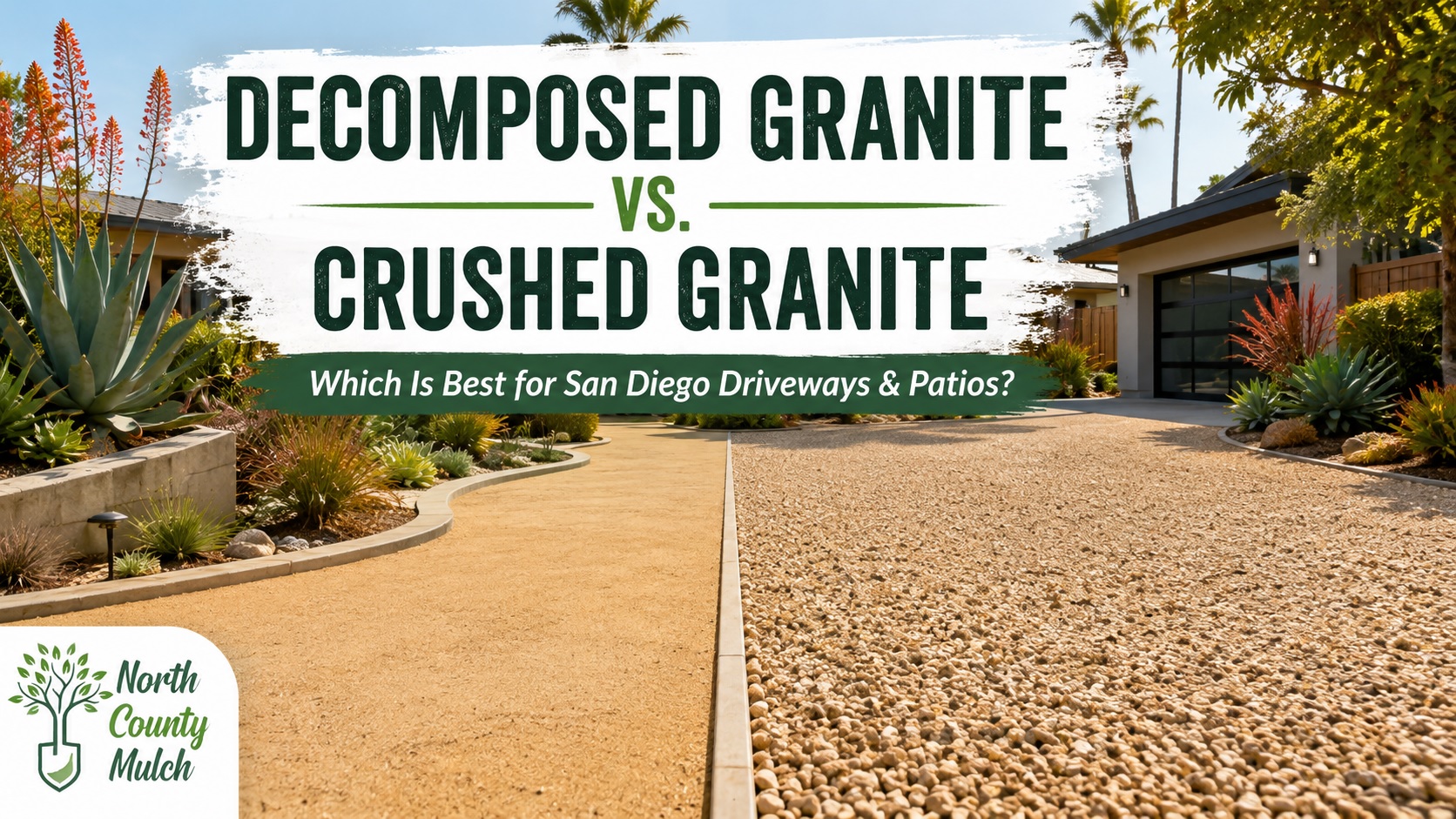
Decomposed granite works best for natural-looking walkways, garden paths, and patios where a smooth, compacted surface matters. Stabilized DG adds a binder that improves strength and limits loose material, making it better for busy patios and some residential driveways. Crushed granite contains larger, angular particles that handle drainage and vehicle traffic more effectively. For a durable driveway, we commonly recommend a compacted Class 2 base beneath stabilized DG or crushed granite. California also recognizes decomposed granite and small gravel as permeable hardscape materials that can help reduce runoff when the entire system is designed for infiltration.
San Diego homeowners often choose granite hardscaping to reduce irrigated lawn area, create usable outdoor space, and complement drought-tolerant landscaping. The right material depends on traffic, slope, drainage, surface texture, and expected maintenance.
Decomposed Granite vs. Crushed Granite
Decomposed granite, commonly called DG, forms as granite naturally weathers into small particles and fines. Those fines help the material compact into a relatively smooth surface.
Crushed granite is mechanically crushed into angular rock pieces. Depending on the product, it may contain some fines, but the finished surface generally remains coarser than DG.
| Feature | Raw DG | Stabilized DG | Crushed Granite |
|---|---|---|---|
| Surface | Smooth and natural | Firm and compact | Coarse and textured |
| Best use | Paths and low-traffic patios | Patios, walkways, light driveways | Driveways, drainage, parking areas |
| Compaction | Good | Very good | Good with proper gradation |
| Drainage | Moderate | Depends on system design | Strong between larger particles |
| Maintenance | More frequent | Lower than raw DG | Periodic raking and replenishment |
| Vehicle durability | Limited | Better with a strong base | Usually the strongest surface choice |
Raw DG for Walkways and Casual Patios
Raw DG provides an informal, natural appearance that works well around drought-tolerant gardens, fire pits, stepping stones, and low-traffic seating areas. It compacts better than rounded gravel and feels more stable underfoot.
Because raw DG contains no binder, wind, stormwater, foot traffic, and tires can gradually move the surface. Material may collect near edges or track onto adjoining pavement. Current cost guidance also notes that unstabilized DG generally requires more erosion repair than stabilized material.
Choose raw DG when appearance and affordability matter more than maximum surface strength.
Is Stabilized DG Best for a Driveway?
A stabilized DG driveway contains a binding product mixed with decomposed granite. The binder helps particles resist movement while preserving the natural stone appearance. Properly engineered stabilized DG is used for pathways, patios, parking areas, and crushed-stone driveways.
Stabilized DG can support residential vehicles when installed over a properly graded and compacted base. However, the binder cannot correct weak soil, poor drainage, inadequate depth, or missing edge restraints.
For driveways, we recommend reviewing our guide to Class 2 base installation. Class 2 aggregate base combines multiple particle sizes that compact into a dense structural layer. Caltrans formally recognizes Class 2 as an aggregate base used within pavement structures.
When Crushed Granite Is the Better Choice
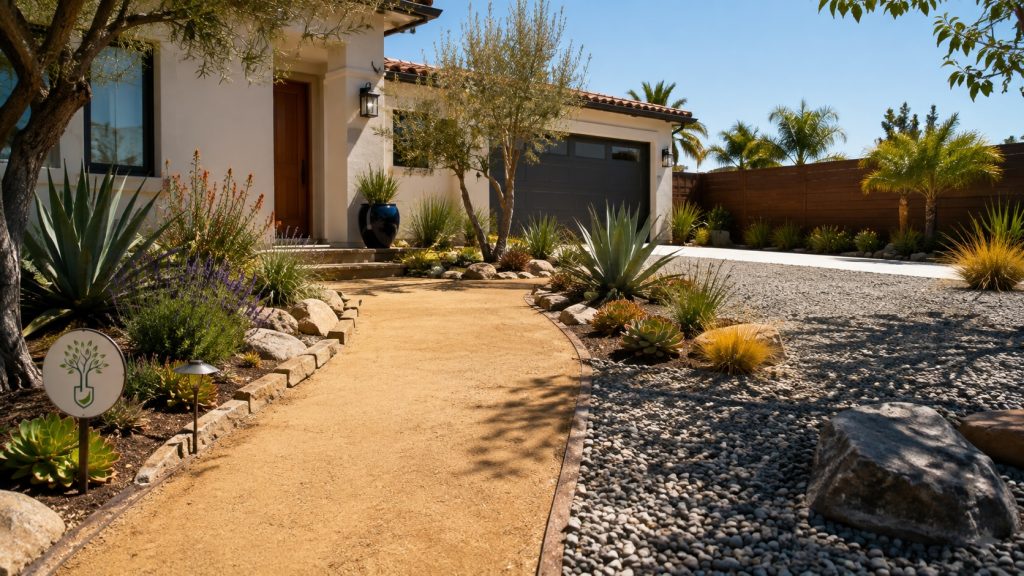
Crushed granite is usually the better option for regular vehicle traffic, drainage strips, utility areas, parking pads, and rustic driveways. Its angular particles interlock under compaction, while the coarser texture is less likely to create the soft, powdery surface associated with worn raw DG.
The tradeoff is comfort. Crushed granite may feel rougher under bare feet and may not provide the smooth finish desired around dining areas or poolside patios.
Weed Control and Drainage
Neither DG nor crushed granite eliminates weeds. Seeds can settle into dust and organic debris that accumulate on top of the finished surface. Good preparation helps reduce growth:
- Remove existing roots and vegetation.
- Establish the correct finished slope.
- Compact the subgrade and structural base.
- Install secure edging.
- Apply the surface material in compacted lifts.
- Remove leaves and soil before they decompose.
Permeable hardscape can reduce runoff, but drainage depends on the complete assembly, including the subgrade, base, slope, edging, and nearby discharge points. California recommends permeable materials such as small gravel and DG where water can seep into the ground.
Decomposed Granite Installation Cost per Sq. Ft.
Installed pricing varies by excavation, depth, stabilizer, base material, access, edging, drainage, and delivery distance.
For general planning, 2026 national examples place a 3-inch DG patio near $2 per square foot and a 6-inch DG driveway near $3.50 per square foot before difficult site preparation. A separate national estimator places basic crushed granite installation around $1.21 to $2.47 per square foot. San Diego contractor quotes may be higher when projects require grading, demolition, drainage correction, or a substantial Class 2 base.
Coastal vs. Inland San Diego Maintenance
San Diego receives most of its seasonal rainfall during winter, while coastal locations experience more fog and inland areas receive stronger sunshine and heat.
For coastal properties, inspect DG after winter storms, clear drainage outlets, refill washed edges, and prevent irrigation overspray from keeping the surface soft.
For inland properties, watch for dust, loose fines, and surface cracking during prolonged dry weather. Light moisture may be needed before recompaction, based on the stabilizer or material specification. Avoid flooding dry DG because concentrated runoff can create channels.
Order Bulk Granite and Base Material
North County Mulch supplies bulk Decomposed Granite, Crushed Granite, and Class 2 Base for patios, pathways, driveways, parking pads, and low-water landscapes. Measure the project area, confirm the required compacted depth, and contact our team to calculate cubic yardage for pickup or delivery across North County San Diego.