
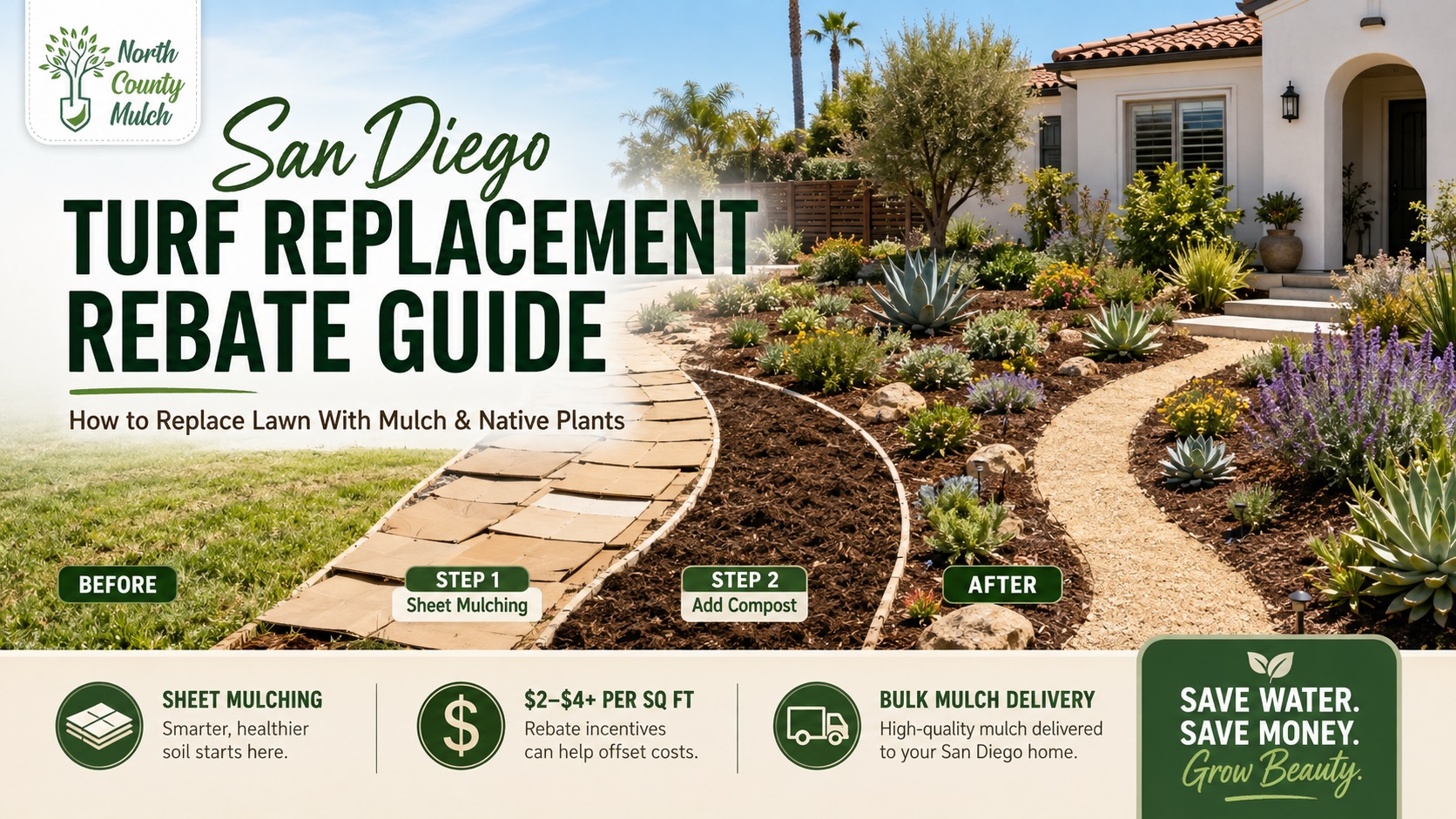
San Diego homeowners may qualify for turf replacement rebates starting at $2 per square foot through SoCal Water$mart, while qualifying properties in unincorporated San Diego County may receive $3 to $4 per square foot, with another $1 per square foot available for eligible California native plant areas. Programs require approval before grass removal and generally require at least three plants per 100 square feet, permeable landscaping, irrigation modifications, and a stormwater retention feature. For homeowners wondering how to replace lawn with mulch, sheet mulching with overlapping cardboard, compost, and about 3 to 4 inches of coarse organic mulch can convert turf without hauling away large amounts of soil. Rebate amounts and funding change, so eligibility should always be confirmed before work begins.
How Much Is the San Diego Turf Replacement Rebate?
The primary regional program administered through SoCal Water$mart currently starts at $2 per square foot, covering as much as 5,000 square feet of residential turf per year. Local water agencies may offer additional incentives.
For qualifying properties in unincorporated San Diego County, available incentives can reach:
| Landscape Conversion | Potential Rebate |
|---|---|
| SoCal Water$mart base incentive | $2/sq. ft. |
| Qualifying County turf replacement | $3 to $4/sq. ft. |
| California native plant bonus | Additional $1/sq. ft. |
| Certain County-only projects | Up to $4/sq. ft. |
| County project using qualifying native plants | Up to $5/sq. ft. |
Exact amounts depend on location, water provider, funding, and project eligibility.
Important 2026 note: San Diego County currently states that qualifying municipal-water customers receiving a SoCal Water$mart Notice to Proceed during July or August 2026 will not receive the County’s $1-per-square-foot supplemental incentive. The County recommends waiting until September 1, 2026 to submit a new SoCal Water$mart application when that supplemental rebate matters.
Apply Before Removing Any Grass
This step can determine whether the entire project qualifies.
Do not remove, kill, scalp, or sheet mulch the lawn before receiving approval.
SoCal Water$mart requires homeowners to reserve rebate funds before starting. Applicants generally need at least five pre-project photos, a recent water bill, measurements, and a basic landscape plan showing the proposed stormwater feature. Once approved, homeowners normally receive 180 days to complete the conversion.
Projects generally must also include:
- At least 3 plants per 100 square feet
- A rainwater retention or filtration feature
- Permeable landscape surfaces
- Removal or modification of overhead spray irrigation
- No remaining turf or turf-looking grass
Mulch alone does not satisfy the full rebate requirements.
For current eligibility, check the official SoCal Water$mart Turf Replacement Program.
How to Replace Lawn With Mulch Without Excavating Everything
For many yards, sheet mulching grass removal provides a practical alternative to stripping and hauling away the entire lawn.
At North County Mulch, we recommend planning the finished grade first because adding compost and several inches of mulch raises the landscape surface.
Step 1: Prepare the Lawn
After rebate approval, mow the grass very short. Remove irrigation heads that will no longer be needed and clearly mark drip-line locations.
Bermuda grass requires extra attention because underground rhizomes and runners can survive around borders. Digging a clean perimeter edge and removing obvious runners near sidewalks and planting zones can reduce future regrowth.
Step 2: Add Cardboard
Lay plain corrugated cardboard directly over the lawn.
Overlap seams by roughly 6 inches so grass cannot easily grow between sheets. Wet the cardboard thoroughly so it conforms to the soil.
Avoid glossy cardboard, plastic coatings, tape, and heavily printed packaging.
Step 3: Add Compost
Applying compost above the cardboard introduces organic matter that can support future native and drought-tolerant planting beds.
North County Mulch offers bulk compost delivery throughout San Diego County, making larger lawn-conversion projects easier to stage without dozens of individual bags.
Step 4: Apply 3 to 4 Inches of Mulch
Finish the sheet-mulched area with approximately 3 to 4 inches of coarse bark or wood mulch.
A deeper organic layer helps block sunlight from reaching grass underneath while reducing evaporation and moderating soil temperature.
For a 1,000-square-foot lawn, a 3-inch mulch layer requires about:
1,000 × 0.25 ÷ 27 = 9.3 cubic yards of mulch
A 4-inch layer requires roughly 12.3 cubic yards.
That volume makes bulk delivery far more practical than purchasing bagged mulch.
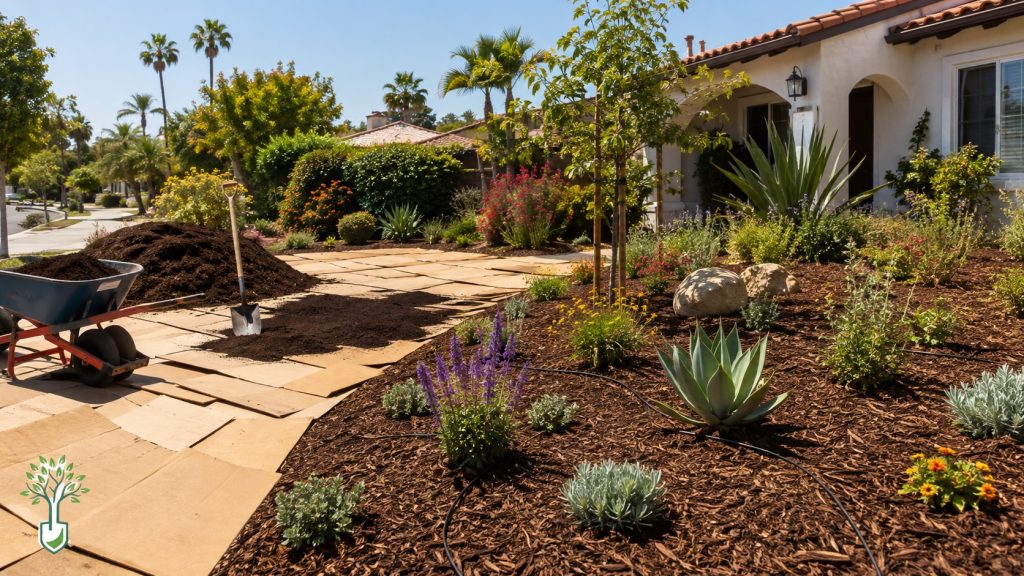
Add California Native and Drought-Tolerant Plants
Rebate landscapes need more than brown mulch surrounding a few shrubs.
Use the required plant density to create a layered landscape with native groundcovers, flowering perennials, shrubs, and small trees. Native plant areas may also qualify for additional County incentives where available.
Drip irrigation can then target individual root zones instead of watering an entire lawn surface.
What Does It Cost to Convert a Lawn to Drought-Tolerant Landscaping?
The cost to convert lawn to drought tolerant landscaping depends heavily on plant selection, irrigation work, mulch depth, drainage features, and whether labor is DIY or professionally installed.
For example, a 1,000-square-foot qualifying project at $2 per square foot could generate a $2,000 rebate. A qualifying $4-per-square-foot program could reach $4,000, while native-plant incentives may increase potential savings further.
Rather than viewing mulch, compost, plants, and drip irrigation as separate expenses, we recommend comparing the total landscape investment against the rebate reserved for the property.
Build the Material Order Before Installation Day
Large turf conversions require more bulk material than many homeowners expect. Measuring first helps avoid running short halfway through installation.
At North County Mulch, we can help San Diego County homeowners calculate bulk mulch and compost quantities and coordinate delivery for lawn conversion projects.
For additional product options, review our guide to the best mulch types for drought-tolerant California landscaping.
Planning a rebate-funded lawn conversion? Order bulk mulch, compost, and landscape materials from North County Mulch and have the materials delivered directly to the project site.