
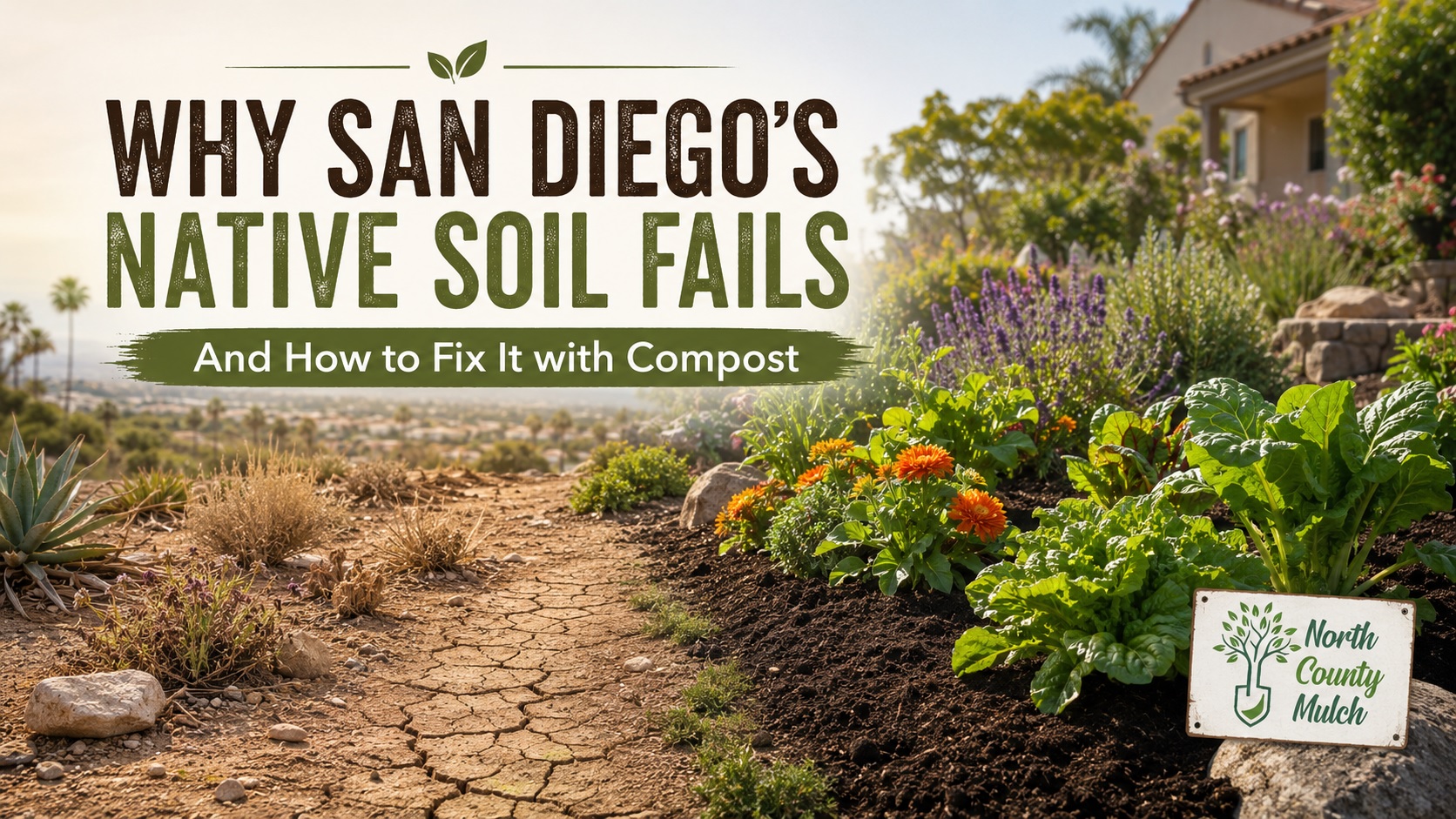
San Diego yards often struggle because local soil can be compacted, sandy, low in organic matter, or heavy with clay. The best fix is not always more dirt. For many lawns and gardens, compost works as a soil amendment that improves structure, water movement, moisture retention, and microbial activity. UC Master Gardener guidance notes that compost and other decomposed organic materials help both sandy and clay soils, giving sandy soil better water-holding capacity and making clay soil easier to work.
The Real Problem Beneath San Diego Landscapes
Many North County homeowners plant the right shrubs, install fresh sod, water consistently, and still watch plants struggle. The problem is often not the plant. It is the soil.
Across San Diego County, yards can shift from coarse sandy soil near coastal areas to dense, compacted clay inland. Newer homes may also have construction-compacted soil that sheds water, blocks root growth, and leaves plants sitting in lifeless ground. UC guidance on soil structure explains that healthy soil needs pore space for air and water, because roots and soil organisms need both to function.
That is why improving clay soil San Diego properties start with usually takes amendment work, not a quick layer of bagged dirt.
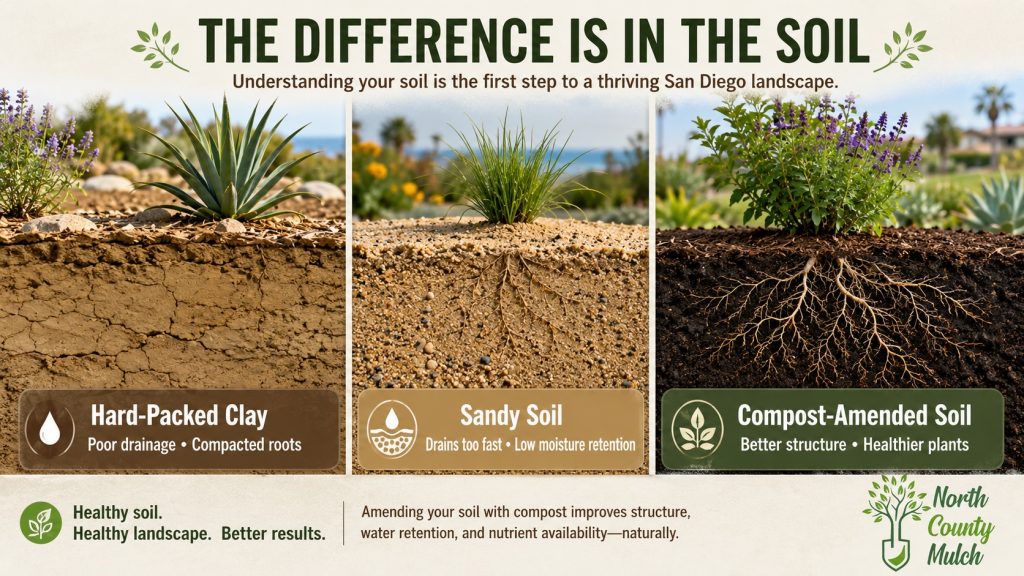
Clay Soil Holds Water But Suffocates Roots
Clay soil is made of very fine particles. That can be useful because clay holds nutrients well, but it also compacts easily. Once clay is hard-packed, water may run across the surface instead of moving down into the root zone.
The wrong fix is adding sand directly into clay and expecting instant loam. A better approach is adding organic compost for garden beds, turf repair, and planting zones over time. UC Master Gardener guidance states that adding organic matter is usually the most effective solution for poor structure or difficult soil texture.
At North County Mulch, our recommendation is simple: build the soil before blaming the plant.
Sandy Soil Drains Fast And Loses Nutrients
Sandy soil has the opposite problem. It drains quickly, which can be helpful after rain, but it often fails to hold enough moisture or nutrients for lawns, vegetables, and ornamentals.
Compost helps sandy soil by adding organic matter that improves water-holding capacity. UC ANR notes that compost applications can increase water holding capacity by reducing bulk density and increasing porosity, with strong benefits often seen in sandy soils with low organic matter.
For San Diego homeowners, that matters during hot, dry weather. Better soil structure means irrigation has a better chance to stay where roots need it instead of disappearing below the active root zone.
Topsoil vs Compost for Lawn Repair
One of the most common questions is topsoil vs compost for lawn improvement. The answer depends on the goal.
| Product | Best Use | What It Does |
|---|---|---|
| Topsoil | Filling low spots, grading, sod base | Adds mineral soil volume |
| Compost | Soil improvement, lawn topdressing, garden amendment | Adds organic matter and improves structure |
| Topsoil and compost blend | Lawn repair, raised beds, planting areas | Balances volume with soil improvement |
Topsoil can help reshape a lawn, but compost changes how the soil works. For thin lawns in San Diego, a compost-rich topdressing can support soil biology while improving moisture movement and root access.
Soil Amendment Tips for San Diego Homeowners
The amendment process should be slow, even, and matched to the planting area.
For new garden beds, spread about 2 inches of compost and gently mix it into the top 6 to 8 inches of soil. UC Master Gardener guidance recommends this approach to improve soil structure, infiltration, and microbial activity. For maintenance, about 1 inch of compost can be added to existing beds and mixed into the upper few inches.
For lawns, avoid burying grass under too much material at once. Use a light compost topdressing, rake it evenly, and water it in.
For shrubs and trees, amend a wide planting zone rather than only the planting hole. UC guidance warns that amending only individual holes can limit root expansion and create drainage issues.
Why Compost Works Better Over Time
Compost is not just filler. It feeds the soil system. NRCS explains that soil organic matter helps improve structure, increases water infiltration, reduces runoff, and holds far more water and nutrients than the same amount of mineral soil.
That is why our approach at North County Mulch focuses on amendment, mulch, and long-term soil protection. Compost improves the root zone. Mulch protects the surface. Together, they help San Diego landscapes handle heat, dry spells, irrigation limits, and poor native soil conditions.
Fix the Soil Before Replacing the Plants
When San Diego plants fail, the real issue is often below the surface. Clay needs structure. Sand needs moisture retention. Compacted soil needs organic matter. Compost helps solve all three by improving how soil holds air, water, and nutrients.
For better garden beds, stronger lawns, and healthier plants across North County San Diego, start with the ground itself. North County Mulch supplies compost, mulch, and topsoil products that help homeowners build soil that actually supports growth.